VW Beetle
Why an Air-Cooled VW Beetle Overheats
Diagnose common VW Beetle overheating causes, including fan-belt faults, missing engine tin, timing, mixture, valve adjustment, airflow, and oil cooling.
VW Beetle
Diagnose common VW Beetle overheating causes, including fan-belt faults, missing engine tin, timing, mixture, valve adjustment, airflow, and oil cooling.
If an air-cooled VW Beetle is dangerously hot, stop safely and investigate before continuing; a failed belt or cooling-air fault can damage the engine quickly.
A hot smell, difficult restart, warning light, or loss of power does not by itself identify the failed component. Record the conditions in which the symptom appeared and distinguish a cooling fault from an oil-pressure, ignition, fuel, exhaust, or mechanical problem before making an adjustment.
Establish a baseline while the engine is cool: note the installed distributor and carburetor or injection system, belt and pulley arrangement, engine tin, seals, thermostat hardware where fitted, oil level, and recent work. That record makes later measurements easier to interpret and prevents one unknown change from being mistaken for a diagnosis.
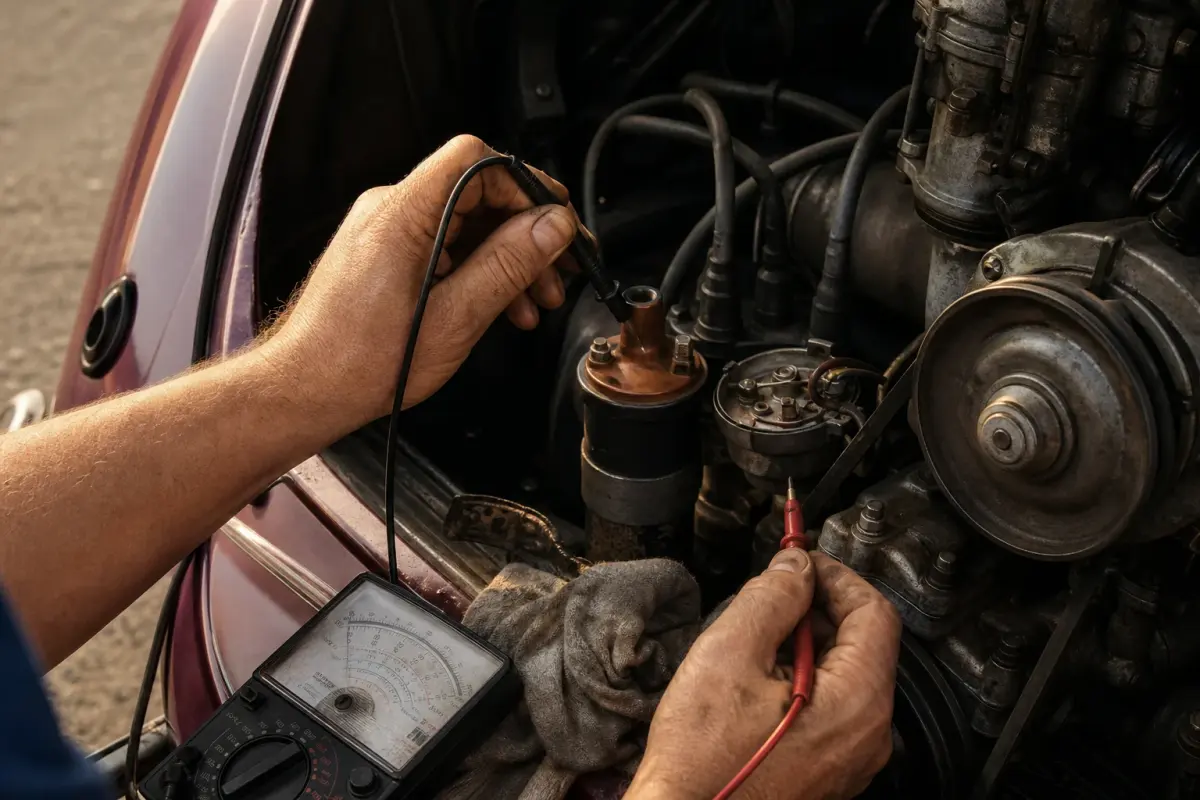
Confirm the symptom before changing parts. Many Beetles do not have a factory temperature gauge, so use the warning indicators, repeatable observations, suitable instruments, and service information for the installed engine rather than relying on touch or smell alone.
A hot-running Beetle may show signs like pinging under load, loss of power, oil warning light flicker, hot oil smell, or hard restarting after a drive. If the oil pressure warning light comes on while driving, do not “just make it home.” Stop, check the oil level, and investigate. Treat an illuminated oil-pressure warning light as a reason to stop safely and investigate.
If additional temperature monitoring is needed, select a gauge and sender suitable for the engine and interpret the readings against appropriate service information. Use repeatable measurements rather than guesswork.
If there is a warning light, loss of power, severe detonation, smoke, an oil leak, an abnormal smell, or another sign of immediate danger, move to a safe place and stop. Do not open or touch hot components. Let the engine cool and arrange inspection rather than attempting to reach a destination at any cost.
The cooling fan moves air through the shroud and across the cylinder heads and cylinders. Engine tin and seals keep hot exhaust-side air separate from the cooler air entering above the engine. Oil also carries heat, while ignition timing, mixture, valve adjustment, belt condition, and engine load influence how much heat is produced.
Volkswagen’s own Beetle history describes the long-running air-cooled boxer layout, while its 1302 model archive records how cooling arrangements evolved on later cars. Use service information for the exact engine and cooling system installed rather than assuming every Beetle has the same parts.
On an air-cooled Beetle, the belt does more than charge the battery. It drives the cooling fan. If the belt is loose, slipping, contaminated, cracked, or missing, fan speed and cooling airflow can fall.
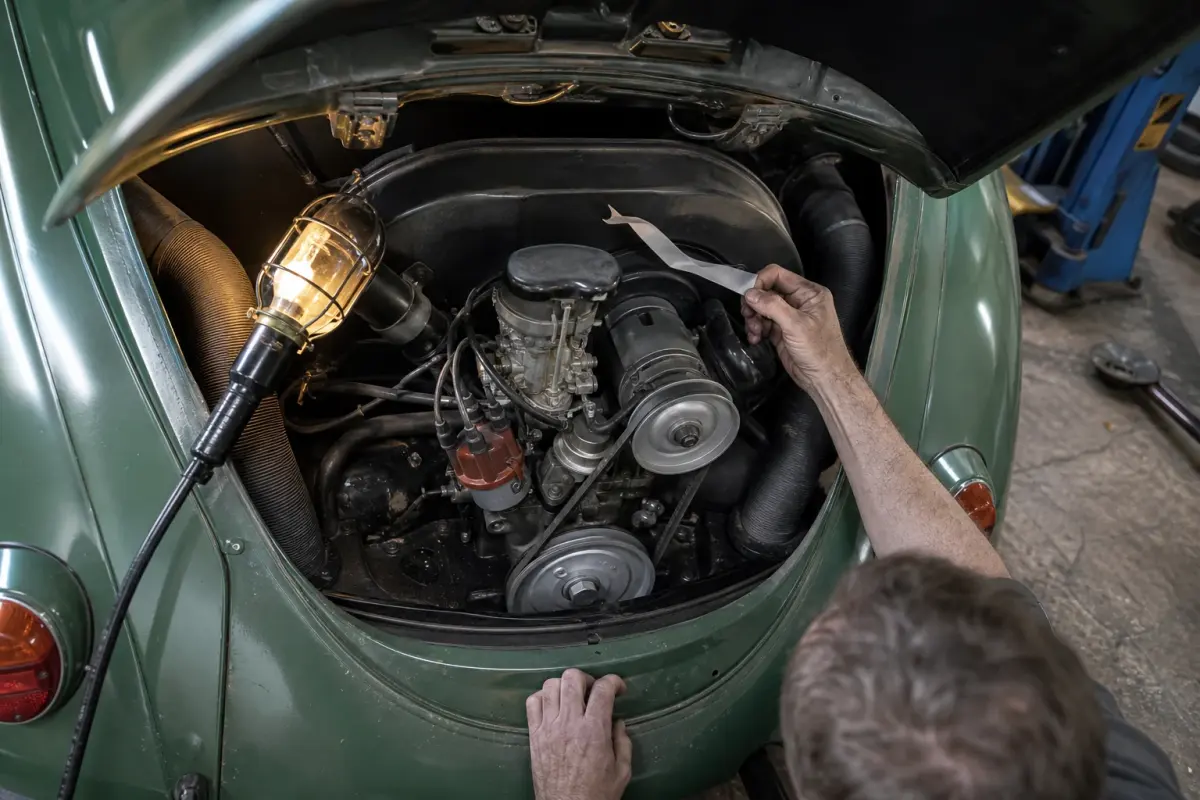
With the engine stopped, inspect whether the belt is present, correctly routed, intact, and adjusted according to the vehicle’s service information. A slipping or failed belt can reduce fan speed and charging. Do not place hands, clothing, or tools near a running belt, pulley, or fan. Replace damaged parts before further diagnosis.
The Beetle cooling system depends on sealed airflow. The fan pushes cool air through the fan shroud, over the oil cooler, and across the cylinder heads and barrels. The engine tin and rubber seals separate the cool upper engine bay from the hot lower exhaust area.
If tinware is missing, incorrectly fitted, or the engine-bay seal is damaged, the fan can draw heated lower-engine air back into the cooling intake. That recirculation reduces the temperature difference available for cooling and needs to be corrected.
Check for missing cylinder tins, rear breast plate, sled tins, deflector plates, and the seal around the engine bay. An open or modified engine requires configuration-specific guidance. On a standard closed engine bay, missing tin can allow hot air to recirculate and must be corrected.
Inspect the airflow path from the fan intake to the underside exits. Verify that the fan is unobstructed, the shroud matches the installed engine, the oil-cooler path is complete, and each opening is sealed or connected as the relevant configuration requires. Photograph missing or modified pieces before ordering replacements.
An air-cooled VW that is timed incorrectly can run hot. Too much advance can cause pinging and high cylinder head temperatures. Too little advance can also make the engine feel lazy and hot because combustion is happening at the wrong time.
Use the correct timing procedure and specification for the installed distributor and engine rather than copying a setting from a different combination. Vacuum-only, mechanical advance, and SVDA distributors are not all set the same way.
An excessively lean mixture can also contribute to high combustion temperature. Vacuum leaks, blocked carb jets, incorrect carb tuning, or fuel injection issues can make the engine run too lean. Lean engines run hot. They may also run just well enough to fool you until they start damaging parts.
Record idle timing and total advance only with the procedure and engine speed specified for the installed distributor. Check advance operation and intake sealing before changing mixture settings. Alter one verified fault at a time, then repeat the same operating check so the effect of that change is clear.
Incorrect valve clearance can affect sealing, heat transfer, and valve life. The required clearance and adjustment condition depend on the engine, valve-train components, and service specification, so verify them before making an adjustment.
If the adjustment history is unknown, inspect and measure the clearances using the correct service procedure before deciding what work is required.
Record the measured clearance at every valve and compare it with previous service notes when available. A clearance that repeatedly closes, an adjuster with little remaining travel, or inconsistent compression can indicate a condition that needs deeper inspection rather than another routine adjustment.
Yes, the Beetle is air-cooled, but oil also carries heat away from internal engine parts. Keep the oil level correct and change it regularly. Low oil, old oil, or a clogged oil cooler will not help your temperature problem.
Do not overfill the engine hoping extra oil will make it cooler. That can create its own problems. Use the correct amount and grade for your climate and engine condition.
Check the oil level on level ground using the correct procedure and inspect for leakage, contamination, unsuitable viscosity, excessive dilution, and restricted cooling airflow. Too little or too much oil can both cause problems. An external cooler or different oil does not correct missing tin, bad timing, poor sealing, or internal engine damage.
Do not remove thermostat-controlled cooling parts on the assumption that unrestricted airflow will improve every operating condition. Confirm the correct configuration for the installed engine.
The factory system uses thermostat-controlled cooling. The flaps help the engine warm up correctly and direct airflow where it needs to go. Running without them may not instantly destroy the engine, but it can cause uneven warm-up, poor cold running, and less controlled cooling. These components form part of the designed warm-up and airflow system and should be assessed together.
Inspect the engine-bay seal, rear tin, heater openings, hoses, lid arrangement, and any hole that can pull hot lower-engine air back into the fan intake. Confirm that thermostat flaps and linkage, where fitted, move and fail safely. Changes to the deck lid or cooling path should be evaluated as a system, not copied blindly.
If your air-cooled VW Beetle is overheating, check in this order: fan belt, engine tin and seals, thermostat/flaps, ignition timing, fuel mixture, valve adjustment, oil level, and oil cooler condition.
Use a written diagnosis order and record each result: immediate warning signs, belt and fan drive, oil level, visible obstruction, tin and seals, thermostat hardware, ignition timing and advance, mixture and intake sealing, valve clearance, and oil-cooling condition. Escalate to compression, leakage, exhaust, or internal inspection only when the earlier checks support it.
Seek a specialist when the engine has been modified, the cooling system is incomplete, the cause is not reproducible, measurements conflict, or the engine shows low oil pressure, abnormal noise, repeated valve movement, compression loss, or visible damage. Continue with the hot-start guide only if the symptom is a restart fault rather than overheating itself.
Diagnosis order
Stop if there is a sign of immediate danger. Once the engine is safe to inspect, use the observed symptom to verify one system at a time instead of changing several parts together.
| Observation | First safe check | Then verify |
|---|---|---|
| Warning light, loss of power, severe detonation, smoke, leakage, or another immediate danger sign | Move to a safe place, stop the engine, and let it cool. | Arrange inspection before restarting when the cause or safe condition is uncertain. |
| Damaged, loose, or incorrectly routed belt; fan concern; visible obstruction | With the engine stopped, inspect the belt, pulley path, fan operation, oil level, and visible air path. | Correct the verified fault before running the engine again. |
| Cooling-air path is incomplete or hot air can return to the intake side | Inspect cooling tin, seals, deflectors, hoses, and missing or displaced pieces. | Restore the separation between cool intake air and heated lower-engine air using the correct parts and procedure. |
| No obvious belt, fan, oil-level, or air-path fault | Identify the installed engine and distributor before using a specification. | Check timing, advance, mixture, and valve clearance with the correct service procedure. |
| The fault remains after the preceding checks | Keep the diagnosis measured and change only what testing supports. | Use suitable service information for compression, leakage, exhaust restriction, oil-cooling, or internal-engine testing. |
Follow the path in order so one missing seal or obstruction is not hidden by a later adjustment.
References
Use the source that matches the vehicle, year, installed parts, and location. A general guide cannot replace the correct service information or an inspection of the individual car.
Volkswagen’s model history and overview of the rear-engine, air-cooled Type 1 design.
Official repair-guide archive for specified Volkswagen Type 1 and Beetle model ranges; use only the guide that matches the individual vehicle and year.
Fitment support
Tell us your Volkswagen model, year, and the part you are considering.
Related parts
See parts related to this guide and ask about fitment before checkout.
Browse matching partsContinue reading
Share your VW model, year and part, or include your order number.
Start a new chat for another question. Our support team will still have the closed conversation.